Expense automation has long operated on a straightforward principle: machines that can read text can handle the work. But that assumption breaks down the moment a receipt emerges from a pocket crumpled, faded, or missing critical information like a merchant's city or a legible date. When OCR hits these gaps, automation stalls and employees are left filling in the blanks manually.
SAP Concur's engineering team saw an opportunity to move past this limitation. While competitors focused on refining conversational interfaces, SAP Concur identified a more fundamental shift: the next efficiency breakthrough wouldn't come from better text recognition, but from machines that could reason through incomplete data.
The outcome is an agentic AI enhancement to ExpenseIt that transforms expense automation from a text-reading exercise into an intelligent problem-solving system. Employees now capture receipts via mobile photo, digital upload, or email forwarding, and ExpenseIt converts them into complete expense entries without manual data entry or line-item categorization.
Executing this vision required a partner capable of both technical innovation and rapid deployment. SAP Concur chose Google Cloud, the only provider that controls the entire AI stack from custom silicon and data infrastructure to frontier models and agent frameworks. The collaboration produced a genuine advancement in expense management: an AI agent that doesn't just capture receipt data but interprets the business context behind each transaction.
Engineering intelligence at scale
Traditional expense systems excel at extracting visible text but fail when information is absent. SAP Concur recognized that emerging AI agent capabilities could create systems that reason, decide, and act on incomplete data.
Consider a lunch receipt from "The Main St. Café" that lacks an address. Previously, this missing field would halt automation entirely, forcing manual data entry before processing could continue.
Agentic capabilities enable the system to analyze contextual signals—vendor names, expense categories, travel itinerary data—to complete the picture. SAP Concur designed an AI agent that mimics human reasoning: "This receipt shows 'Main St. Café.' The transaction timestamp aligns with a business trip involving a Dallas flight and a Greenville, Texas hotel booking. The vendor is most likely the restaurant near the hotel in Paris, Texas—not Paris, France."
The teams approached development with startup velocity, prioritizing rapid prototyping over extended planning cycles.
Using Google's Gemini models, they built the Receipt Analysis Agent on a cognitive architecture that works through five stages:
-
Ingestion: Users submit receipts through the SAP Concur mobile app, file upload, or email forwarding.
-
Deterministic core: SAP's established technology, refined through years of global expense processing, extracts visible text with high accuracy.
-
Intelligent routing layer: Clear receipt data bypasses additional processing. Ambiguous data (such as "Missing location") triggers the Receipt Analysis Agent.
-
Contextual reasoning: The Gemini-powered agent infers missing information using grounding data including travel itineraries and calendar entries rather than generating guesses.
-
ReAct framework: The agent validates vendor information against location history and completes the expense entry.
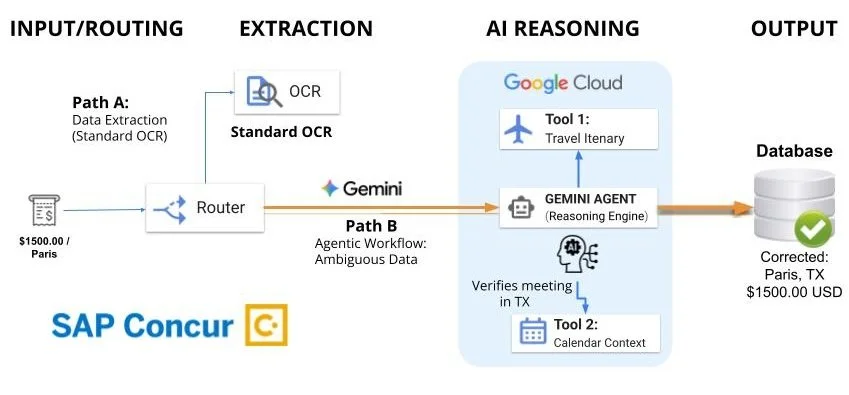
ExpenseIt with agentic AI (Receipt Analysis Agent)
In practice, ExpenseIt detects missing location data, activates the intelligent routing layer, and triggers the Receipt Analysis Agent. The Gemini-based agent identifies the gap, analyzes contextual signals and user-specific data, and makes decisions grounded in travel bookings and calendar information.
Core design patterns for production AI agents
The Receipt Analysis Agent implements principles from Agentic Design Patterns, a technical guide by Google senior engineer Antonio Gulli. This framework enabled SAP Concur to transform ExpenseIt into a system that reasons across both receipt data and external context to generate accurate expense entries.
The teams implemented the Routing Pattern to optimize for both cost and performance by avoiding unnecessary AI agent invocations. The routing architecture classifies incoming tasks: high-confidence OCR results follow the standard deterministic path, while low-confidence scores (such as "Missing location") route to the Receipt Analysis Agent.
The Reflection Pattern addresses challenges like the Paris Paradox, ensuring the agent validates its reasoning rather than generating unchecked outputs. This pattern creates an internal generator-critic loop where the model proposes a hypothesis ("This is Paris, France") then critiques it against known facts ("The itinerary shows Dallas, Texas. This hypothesis is incorrect.").
The agent also employs the Tool Use Pattern, providing direct API access to grounding sources like Concur Travel itineraries. This architecture enables the agent to retrieve factual information rather than generate plausible-sounding but potentially incorrect data, transforming the system from a text generator into a fact-based reasoning engine.
Building for incomplete data: Google Cloud's integrated advantage
This implementation represents a significant evolution in intelligent system design. By pairing a deterministic foundation with an agentic reasoning layer, SAP Concur demonstrated that AI delivers the most value not by processing existing data, but by reasoning to identify missing information. A critical insight emerged during development: the teams stopped treating Gemini as a generative interface and began deploying it as a logic engine.
SAP Concur selected Google Cloud because agent effectiveness depends on world knowledge—and Google's digital footprint is unmatched.
While the current release leverages Gemini's reasoning capabilities, the partnership creates pathways to multimodal, full-stack intelligence unique in the market:
-
Real-world grounding: Future agents could cross-reference receipts with Google Maps data to verify business locations.
-
Frictionless integration: Potential integrations with Google Wallet could match transaction timestamps automatically, or Gmail could surface hotel receipts without manual forwarding.
-
On-device intelligence: Mobile advances like Gemini Nano and Android AICore could enable sensitive processing directly on devices, delivering speed and privacy without cloud transmission.
SAP Concur provides the domain expertise that underpins global financial transactions. Google Cloud delivers the complete AI infrastructure from custom TPU chips optimized for training to the mobile operating system in users' devices.
Building your own reasoning agent
The architectural patterns demonstrated here—Routing, Reflection, and Tool Use—are available directly in the Google Agent Development Kit (ADK). The ADK provides frameworks and best practices for moving from prompt engineering to system engineering, offering a blueprint for building agents that meet enterprise requirements for reliability and scale.