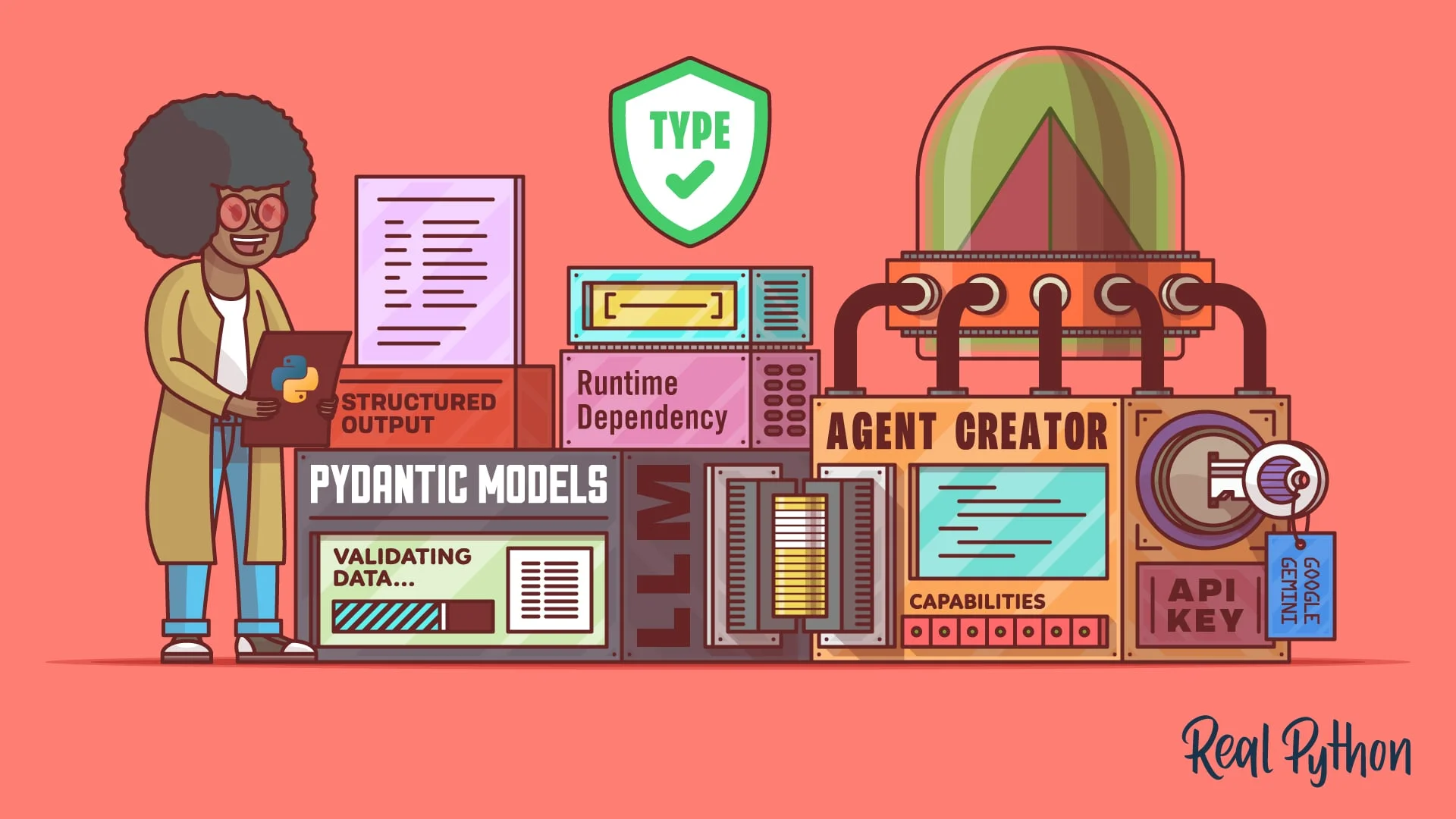
Pydantic AI is a Python framework designed for building LLM agents that deliver validated, structured outputs through Pydantic models. Rather than wrestling with raw string responses from language models, developers receive type-safe objects with built-in validation.
The framework will feel immediately familiar if you've worked with FastAPI or Pydantic—it follows the same pattern of defining schemas using type hints while the framework manages validation automatically.
Key concepts covered in this tutorial:
- Pydantic AI leverages
BaseModelclasses to define structured outputs, ensuring type safety and automatic validation - The
@agent.tooldecorator registers Python functions as tools that LLMs can call based on user queries and function docstrings - Dependency injection via
deps_typeenables type-safe runtime context such as database connections without relying on global state - Validation retries automatically resubmit queries when LLMs return invalid data, improving reliability while increasing API costs
- Google Gemini, OpenAI, and Anthropic models offer the strongest support for structured outputs, while other providers show varying capabilities
Understanding when Pydantic AI fits your project requirements helps you make informed architectural decisions. This comparison table outlines common scenarios:
| Use Case | Pydantic AI | If not, look into … |
|---|---|---|
| You need structured, validated outputs from an LLM | ✅ | - |
| You're building a quick prototype or single-agent app | ✅ | - |
| You already use Pydantic or FastAPI | ✅ | - |
| You need a large ecosystem of pre-built integrations (vector stores, retrievers, and so on) | - | LangChain or LlamaIndex |
| You want fine-grained control over prompts with no framework overhead | - | Direct API calls |
Pydantic AI prioritizes type safety and minimal boilerplate, making it an excellent choice if you appreciate the FastAPI development philosophy.
Get Your Code: Click here to download the free sample code you'll use to work with Pydantic AI and build type-safe LLM agents in Python.
Take the Quiz: Test your knowledge with our interactive "Pydantic AI: Build Type-Safe LLM Agents in Python" quiz. You'll receive a score upon completion to help you track your learning progress:
Interactive Quiz
Pydantic AI: Build Type-Safe LLM Agents in PythonLearn the trade-offs of using Pydantic AI in production, including validation retries, structured outputs, tool usage, and token costs.
Start Using Pydantic AI to Create Agents
Getting started with Pydantic AI requires installing the framework and configuring an API key for your language model provider. This tutorial uses Google Gemini, which provides a free tier ideal for learning and experimentation.
Note: Pydantic AI is LLM-agnostic and supports multiple AI providers. Check the Model Providers documentation page for more details on other providers.
Install Pydantic AI from the Python Package Index (PyPI) using a package manager like pip. Create and activate a virtual environment before running the installation command:
(venv) $ python -m pip install pydantic-ai
This installation includes support for all major model providers: Google, Anthropic, and OpenAI. After installation, configure your preferred provider's API key to start using their models. Most providers require a paid subscription for API access.
Note: You can also power your Pydantic AI apps with local language models. To do this, you can use Ollama with your favorite local models. In this scenario, you won't need to set up an API key.
For a lighter installation with only Google Gemini support, use the slim package:
(venv) $ python -m pip install "pydantic-ai-slim[google]"
Using Gemini's free tier requires a personal Google account. Obtain your Google API key from ai.google.dev to run the tutorial examples.
After obtaining your API key, configure it as an environment variable:
With installation complete and your API key configured, you're ready to build your first agent. All code examples in this tutorial have been technically reviewed and tested by Real Python's team, ensuring they work as demonstrated.
Read the full article at https://realpython.com/pydantic-ai/ »
[ Improve Your Python With 🐍 Python Tricks 💌 – Get a short & sweet Python Trick delivered to your inbox every couple of days. >> Click here to learn more and see examples ]