
The prediction markets industry is taking a significant step toward consumer protection with the launch of a unified self-exclusion network. Kalshi has become the first platform to integrate with SelfExclude, a system operated by IC360 that allows users to block themselves from trading across multiple platforms simultaneously. Polymarket, Robinhood, and ProphetX are expected to join the network soon.
The system eliminates the need to manage exclusions separately on each platform. Users enroll once, and their trading restrictions automatically apply across all participating exchanges.
Understanding SelfExclude and cross-platform exclusion
SelfExclude.io enables users to voluntarily block themselves from prediction market activity across multiple platforms through a single enrollment. The system eliminates the need to configure settings on each individual platform separately.
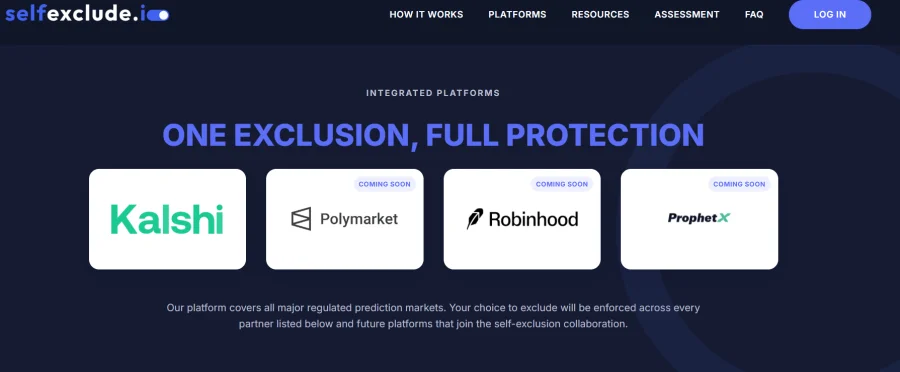
The platform reduces friction for users who need distance from trading. By consolidating the exclusion process, it removes the burden of tracking multiple accounts and login credentials, making it easier to establish healthier financial boundaries.
Privacy protection is central to the system's design. User identities are verified upfront, then converted into encrypted, anonymized data. Participating platforms can verify exclusion status without accessing underlying personal information, ensuring enforcement without compromising privacy.
The significance of Kalshi's participation
Kalshi's integration marks a milestone as the first federally regulated prediction market to adopt a shared exclusion framework.
Sara Slane, Head of Corporate Development at Kalshi, emphasized the importance of unified consumer protections. "This is a big deal," she said. "It underscores the fundamental advantage of a federal framework: the ability to provide consistent, nationwide customer protections, rather than relying on a disjointed state-by-state system."
This is a big deal. It underscores the fundamental advantage of a federal framework: the ability to provide consistent, nationwide customer protections, rather than relying on a disjointed state-by-state system.
— Sara Slane (@Sara_Slane) April 10, 2026https://t.co/ZidtJfhtXV
Slane noted that regulatory fragmentation, not lack of intent, has historically prevented effective safeguards. "Having worked in the industry, I saw this firsthand. It wasn't a lack of effort or intent from operators or regulators. The problem was structural. Conflicting state laws made it virtually impossible to implement consistent, effective protections," she explained.
The enrollment process
Users begin by visiting the SelfExclude platform and completing an identity verification process. This requires standard information including legal name, address, date of birth, phone number, and government-issued identification to ensure only the account holder can initiate restrictions.
After verification, users select an exclusion duration, typically ranging from one month to one year. The system processes the request and distributes it to participating platforms within approximately 24 hours.
During the exclusion period, users are blocked from opening new trades. While some platforms may permit closing existing positions, the primary function of placing new trades remains restricted.
Kalshi's existing self-exclusion features
Kalshi has offered self-exclusion tools independently through its website, API, and mobile app, allowing users to pause trading for specified periods.
The SelfExclude integration expands this capability beyond Kalshi's ecosystem. Rather than limiting restrictions to a single platform, the exclusion now applies across all participating exchanges, providing broader protection for users active on multiple platforms.
Privacy and data security measures
SelfExclude employs a double-hashing process that encrypts user information before storage, avoiding the sharing of raw personal data.
When platforms query the database, they use the same hashing method and receive a binary response indicating match or no match. Names, identification numbers, and contact information remain concealed throughout the verification process.
This architecture prevents reverse-engineering of stored data to reveal identities. All communications are encrypted, and the system is specifically designed to avoid retaining reconstructable personal information.
Historical challenges with cross-platform exclusion
Fragmented regulation, particularly across U.S. states, has historically complicated coordination efforts for consumer protection measures.
Slane highlighted practical obstacles created by regulatory inconsistency. "A clear example was self-exclusion: we were often prohibited from sharing self-exclusion customer lists across state lines, limiting our ability to safeguard individuals who needed it most. This is where regulatory fragmentation can lead to unintended consequences," she noted.
This fragmentation often placed the burden on users. "Instead of prioritizing the customer, stakeholders are forced to navigate a maze of inconsistent requirements. And who gets overlooked…the customer," Slane said.
Post-exclusion account restoration
Access is automatically restored when the exclusion period expires. Participating platforms receive notification, and normal account functionality resumes without requiring user action.
Users can log in during the exclusion period to check their status, view remaining time, or enroll for an extended period if desired.
Exclusions cannot be terminated early. Once a timeframe is selected, it remains active until expiration, preventing impulsive decisions from undermining the protective measure.
Future expansion and regulatory outlook
With additional platforms preparing to join, the network may rapidly expand and establish itself as an industry-standard protection layer.
Slane views this development as part of a broader shift toward consistent safeguards. "Supporting a federally regulated exchange doesn't mean opposing state-regulated, house-backed sports betting. Both models can coexist," she said. "The key difference is that a federal framework enables consistent, nationwide protections, ensuring that customers receive the same safeguards regardless of which state they are located."
Featured image: SelfExclude.io
The post How do you self-exclude from prediction markets? Kalshi joins SelfExclude network appeared first on ReadWrite.